
For support, call or text (646) 906-8098
While we prepare your AI Visibility report card...
Discover What Drives Visibility In AI Search
The Way Patients Search Has Changed
Picture this: A woman in her late 40s, lying awake at 2 AM, scrolling through her phone. She's exhausted, her hormones feel completely out of control, and she's desperate for answers.
But instead of typing "BHRT doctor near me" into Google and scrolling through pages of results, she opens ChatGPT and asks: "Is bioidentical hormone replacement therapy safe? What are the risks? How do I know if it's right for me?"
Within seconds, she gets one synthesized answer. Clear. Conversational. Complete with a couple of citations to clinics or articles the AI deemed trustworthy.
If your clinic isn't named, cited, or linked inside that answer, you simply don't exist to her. Even though your website is beautiful, you've been practicing for years, and your patient outcomes are transformational.
And that’s not fair, I know! But this is the new reality of patient search, and it's happening right now.
Why This Shift Matters To Your Clinic
Here's what's changed: AI assistants have compressed the patient journey. There are fewer clicks, faster decisions, and much higher intent when someone finally does reach out to you.
Think about it… if a patient has already had a detailed conversation with an AI tool about their symptoms, treatment options, and safety concerns, by the time they contact you, they're not browsing. They're most likely to take action in some way.
Patients expect plain-English answers. They want to know what to expect, how long until they feel better, what the risks are, and whether this approach is right for their specific situation. They expect context – ideally, content that's been "medically reviewed" or comes from a credible source. And they want simple next steps: a clear path to book a discovery call or initial consultation.
What's particularly important for local clinics like yours is that patients are routinely embedding location into their prompts. "Functional medicine doctor near me." "BHRT clinic in Austin." "Who treats perimenopause in Denver?" AI assistants are now blending authority with proximity, which means they're looking for practitioners who are not only knowledgeable but also locally relevant and accessible.
How AI Tools "Choose" Their Answers
Let's be honest – most of us aren't AI engineers, and we don't need to be. But it helps to understand, conceptually, what these large language models (LLMs) are looking for when they decide which clinics to cite.
They prioritize clarity. Can they easily understand what you do, who you serve, and what makes you qualified? They look for trust signals – things like medical credentials, "medically reviewed by" statements, and citations to reputable sources. They favor content that's well-structured: clear headings, short paragraphs, bullet points, and answers that get to the point quickly.
They also weigh what's called entity authority. Essentially, is your clinic recognized consistently across the web, in your community? Do you show up in the same way on your Google Business Profile, your website, health directories, and local media? Are your name, address, and phone number consistent everywhere?
And they care about content “freshness” and how recent your content is. Content that's been recently updated signals that the information is current and reliable. Combine that with consistent citations from reputable sources – medical guidelines, research institutions, professional associations – and you become a source AI tools feel safe recommending.
The Blue-Ocean Opportunity You Have Right Now
Here's the thing that should get you excited... most clinics aren't optimizing for AI answers yet!
We're in a moment that's reminiscent of SEO back in 2001 – there's a massive opportunity for early movers, but the window won't stay open forever.
The good news? You don't need a complete website overhaul. You don't need to hire a full-time marketing team. What you need are small, strategic operational changes: formatting your content so it's answer-ready, adding some basic structured data (I won't bore you with the details, but think of it as labels that help AI understand your content), and making sure your Google Business Profile is fully optimized.
These aren't massive investments of time or money, but they unlock disproportionate visibility.
When you start showing up in AI answers, that placement compounds over time. More mentions lead to more reviews. More reviews lead to more citations. More citations lead to more authority. It's a flywheel that rewards the practitioners who act now.
You Don't Need To Be A Tech Expert
Let me be clear about something: you don't need coding skills. You don't need to hire a developer. You don't even need to understand the technical jargon.
What you need is to focus on being the best, clearest, most trustworthy answer to the questions your patients are actually asking. Think of this as patient education done right – comprehensive, compassionate, evidence-based content that lives on your website and is mirrored across the places AI tools look when they're building their answers.
If you can write a clear FAQ, you can do this. If you can explain BHRT safety to a patient sitting in your office, you can translate that same clarity onto your website in a way that AI tools can parse and recommend.
The strategies we're about to walk through aren't complicated. They're methodical. And they work, as I'll explain throughout the rest of this guide.
But if you want hands-on support and want to fast-track your AI visibility, consider joining our upcoming AI Search Bootcamp. We'll work together in live sessions to build your Answer Hub, deploy schema, optimize your Google Business Profile, and create your 90-day action plan – so you leave with work done, not just ideas to implement later.
Now that you understand why this shift matters and what the opportunity looks like, let's dig into what these AI optimization strategies actually are and how they differ from the SEO tactics you might already be familiar with.
AEO, AIO, GEO: What They Mean And How This Differs From Traditional SEO
If you've spent any time researching how to show up in AI answers, you've probably run into a confusing alphabet soup of acronyms: AEO, AIO, GEO, LLMO. Let me cut through the noise and tell you what actually matters.
AEO stands for Answer Engine Optimization. It's about helping AI assistants select your clinic as the answer when patients ask questions like "Is BHRT safe?" or "What is functional medicine?"
AIO means AI Optimization. This is the umbrella term for making your entire digital presence – your website, Google Business Profile, directory listings, even your social media – understandable and trustworthy to AI tools.
GEO is Generative Engine Optimization. This focuses specifically on getting cited by generative AI tools like ChatGPT, Gemini, and Claude when they're creating answers from scratch.
Here's what you need to know: in practice, these terms all point to the same business goal. You want to optimize your website, your Google Business Profile, and your digital footprint across the web so that AI tools feature, cite, or recommend your clinic when patients ask questions you're uniquely qualified to answer.
The Holistic Intent: 3 Pillars
Think of AI visibility as resting on three foundational pillars:
Clarity of answers. Your content needs to be written in plain English that patients can actually understand. No medical jargon unless it's immediately defined. No walls of text. Just clear, compassionate explanations that directly address what patients want to know.
Structure that AI can parse. AI tools don't "read" the way humans do. They look for patterns, headings, bullet points, and structured data that help them quickly identify what your content is about and whether it's trustworthy. When your content is well-organized, AI can confidently pull it into their answers.
Trust signals that reassure both AI and patients. This includes things like "medically reviewed by" statements, provider credentials, citations to reputable sources, and consistent information across all your digital properties. AI tools are cautious – they won't recommend sources they can't verify.
The Big Distinction Between SEO & AI Optimization
If you've invested in SEO over the years, that work isn't wasted. In fact, it's foundational. But here's the critical difference:
Traditional SEO is about ranking on a page of links.
The goal is to show up in position one, two, or three on Google's search results so that when someone searches for "functional medicine doctor Denver," your practice appears in that list.
AI optimization – whether you call it AEO, AIO, or GEO – is about being the actual answer.
AI assistants don't give patients a list of ten blue links to click through. They give one synthesized response, maybe with two or three citations embedded. If you're not in that response, patients may never even know you exist.
This is a fundamentally different game, and it requires some additional strategies beyond what traditional SEO demands.
Here's a helpful way to think about this: about 70% of what makes you visible in AI answers overlaps with solid SEO and local SEO practices you might already be doing. The other 30% is what makes the difference between ranking well and actually being cited.
The 70% That Overlaps With Good SEO
Let's start with what you might already have in place:
A fast, mobile-friendly website with clean navigation. AI tools need to be able to crawl your site easily, just like Google does.
Clear service pages and location pages. Every core service you offer – BHRT, functional medicine, thyroid optimization – should have its own dedicated page. If you serve multiple locations, each one should have real, unique content (not just a different city name dropped into a template).
Accurate Name, Address, and Phone (NAP) information everywhere. Your contact details should be identical across your website, Google Business Profile, and every directory listing. Inconsistencies confuse AI tools and erode trust.
A fully completed Google Business Profile. This means accurate categories, detailed service descriptions, high-quality photos, answered questions, and a steady stream of authentic patient reviews.
Quality backlinks and citations from reputable sources. Links from local news outlets, professional associations, health directories, and relevant industry sites all signal authority.
Helpful, educational content that genuinely answers patient questions. Not hype. Not sales pitches. Real information that helps people make informed decisions about their health.
If you've been doing SEO well, you likely have much of this foundation already. That's the 70%. Now let's talk about the 30% that's unique to AI visibility.
The 30% That's Unique To AI Optimization
This is where the magic happens – the specific adjustments that transform good content into content that AI tools confidently cite:
Answer-ready formatting. This means putting a clear, concise answer in the first two to three sentences of your content – what we call a TL;DR (too long, didn't read). Follow that with five to seven bullet points that break down key information. Use short paragraphs, comparison tables when relevant, and clear guidance on when to seek care. Make it easy for AI to extract the most important information quickly.
Medical trust scaffolding. For health-related content, trust is everything. Include statements like "Medically reviewed by Dr. [Name], Board-Certified in [Specialty]." Make sure your provider bios include credentials, training, and affiliations. Add "last updated" dates to show your content is current. Use language that's balanced and evidence-based, not sensational.
Schema markup tuned for healthcare. Without getting too technical, schema is structured data that acts like labels for your content. It helps AI tools understand that this page is about a medical condition, that person is a physician, this content is an FAQ. You don't need to be a developer to add schema – there are templates and tools that make it straightforward – but having it in place significantly improves your chances of being cited.
Entity graph building. This is about making sure your clinic is recognized as a consistent, credible entity across the web. Link your Google Business Profile to your website, your LinkedIn profile, your YouTube channel, and your directory listings. When AI tools can trace these connections and see that you're consistently represented everywhere, it builds algorithmic trust.
Tracking AI referrals. You can set up simple tracking in Google Analytics to see when traffic comes from ChatGPT, Perplexity, Gemini, or other AI tools. This lets you know whether your optimization efforts are working and which platforms are driving the most interest.
The Takeaway For Non-Technical Practitioners
Here's what I want you to remember: you don't need to master jargon, and you don't need to become a coding expert.
Think of AI optimization as clear patient education presented in a structured way, backed by proof that you're legitimate. That's it.
The 70% that overlaps with SEO is your foundation. The 30% that's unique to AI visibility is your unlock. When you implement both, you transform good SEO into genuine AI inclusion – and that's when you start showing up in the answers patients are actually asking for.
Now that you understand what AI optimization is and how it differs from traditional SEO, let's break down the two concrete steps you need to take to get your clinic recommended in AI answers.
The Two Steps To Getting
Recommended In AI Answers
When you strip away all the complexity, getting cited in AI answers comes down to two straightforward steps. First, make sure AI tools can find and understand your content. Second, make sure they choose your content as the answer. Let's walk through exactly what that means in practice.
Step 1: Be Indexable + Understandable
Before AI tools can recommend you, they need to be able to access your content, crawl it, and make sense of what you're saying. Think of this as setting the table – you're creating the conditions that allow AI to even consider you as a source.
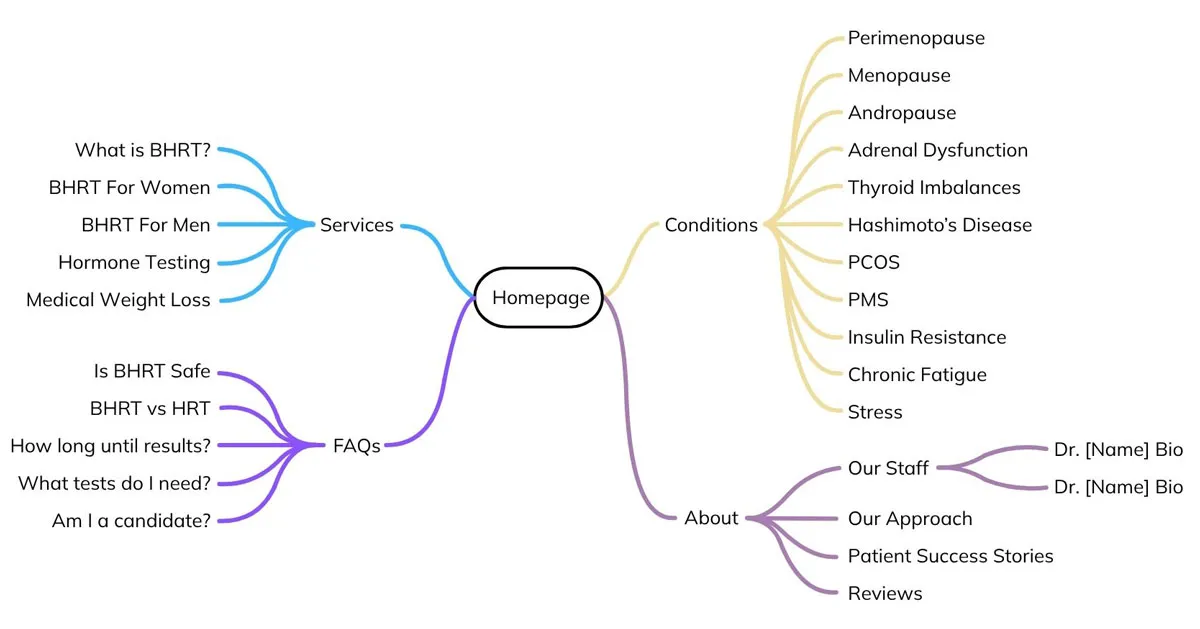
Crawl basics. Your website needs a working sitemap (a file that tells search engines and AI tools which pages exist on your site). Make sure you haven't accidentally blocked pages with "noindex" tags, and minimize anything that hides your content from crawlers – like JavaScript overlays or paywalls that prevent AI from reading your text.
Content basics. You need dedicated pages for each core service and condition you treat. A page for BHRT. A page for functional medicine. A page for thyroid optimization. If you serve multiple locations, each one should have its own page with real, unique information – details about parking, the neighborhood you serve, local practitioners. Templates with just the city name swapped out don't cut it anymore.
Structure basics. Use clear headings to organize your content – H1 for your main title, H2 for major sections, H3 for subsections. Keep paragraphs short (three to four sentences max). Put the most important information – the actual answer to the question – right at the top in a clear TL;DR format. AI tools scan for this kind of structure because it helps them quickly identify what your page is about and extract the key points.
Schema basics. Remember when I mentioned schema earlier and promised not to bore you with the details? Here's the simplified version: schema is structured data you add to your website that acts like labels for your content. It tells AI tools "this is a Frequently Asked Question," "this is a medical clinic," "this person is a physician with these credentials," "this page is about a specific medical condition." You don't need to write code from scratch – there are templates and tools that let you paste in pre-formatted schema markup. Having this in place dramatically improves your chances of being understood and cited.
Trust basics. For health-related content, trust is non-negotiable. Include "medically reviewed by" statements with the name and credentials of the reviewing physician. Make sure every provider has a detailed bio that includes their training, certifications, specialties, and ideally their NPI (National Provider Identifier) number where applicable. Add "last updated" dates to your content so AI tools know the information is current. Use language that's evidence-based and balanced, not hype-driven or sensational.
When you get these fundamentals right, you've cleared the first hurdle. AI tools can find you, understand what you do, and verify that you're legitimate. Now comes the second step: getting chosen.
Step 2: Be Chosen As The Answer
Being indexable gets you in the game. Being chosen as the answer is what wins it. This is where you go beyond technical optimization and focus on creating content that directly serves patient needs in a way that AI tools recognize as authoritative and helpful.
Answer-first content. Structure your content around the actual questions patients are asking. "Is BHRT safe?" "What is functional medicine?" "How long until I feel better on thyroid medication?" "What's the difference between bioidentical and synthetic hormones?" Start each page by directly answering the question in plain English. No preamble. No sales pitch. Just a clear, honest answer in the first two to three sentences.
Clarity and safety. Use plain English. Define any medical terms the first time they appear. Avoid hype and exaggerated claims. For any treatment or approach, include balanced information about what patients can realistically expect, potential side effects or risks, and when they should seek additional care. Remember, AI tools are risk-averse when it comes to health information – they won't cite content that feels promotional or medically unsafe.
Authoritativeness through citations. Include 2-4 reputable citations on each key page. As warranted, link to government health sites (.gov), medical research institutions (.edu), professional guidelines, or peer-reviewed studies. This doesn't mean you need to turn your content into a research paper, but strategic citations signal to AI that your information is grounded in credible sources. Also link to your related services for next steps – this creates internal pathways that help both patients and AI understand how your offerings connect.
Entity authority across the web. Your website is just one piece of the puzzle. AI tools also look at how consistently and credibly you're represented across the broader web. Make sure your Google Business Profile is complete and accurate. Get listed in high-quality health directories like Healthgrades, WebMD, ZocDoc, or specialty-specific platforms. Seek mentions in local news, podcasts, or professional association profiles. The more places AI can verify that you exist and are recognized as a legitimate authority, the more confident it becomes in recommending you.
Freshness matters. AI tools favor recent information because healthcare evolves. Set a cadence to review and update your key pages – quarterly or biannually is reasonable. Add new, geo-tagged photos to your Google Business Profile weekly. Expand your Q&A section weekly. Update statistics or guidelines if new research has emerged. Even small updates signal that your content is actively maintained and trustworthy.
When you get these fundamentals right, you've cleared the first hurdle. AI tools can find you, understand what you do, and verify that you're legitimate. Now comes the second step: getting chosen.
What This Looks Like In Practice
Let's make this concrete. Imagine you're a functional medicine practitioner in Portland. A patient opens ChatGPT and asks: "Is BHRT safe for someone in their late 40s?"
If your website has a dedicated BHRT page that starts with a clear, two-sentence answer explaining that BHRT is generally considered safe when properly monitored by a qualified provider, that side effects are typically mild and manageable, and that individualized dosing is key – AI tools can extract that.
If that same page includes 5 -7 bullet points covering who's a good candidate, what monitoring looks like, common concerns, and when to seek additional evaluation, AI has structure it can parse.
If you've included "Medically reviewed by Dr. Jane Smith, Board-Certified in Integrative Medicine" at the top and cited a couple of reputable sources – maybe a study from a medical journal and guidelines from a professional association – AI sees trust signals.
If your Google Business Profile lists "Bioidentical Hormone Replacement Therapy" as a service, your NAP information is consistent across Healthgrades and your website, and you've been mentioned in a local health podcast or news article, AI can verify your entity authority.
All of this together makes you a strong candidate to be cited. And when you are, that mention drives high-intent traffic – patients who've already educated themselves and are ready to take the next step.
The Promise Of This Approach
Here's what I love about this framework: it's not about gaming the system or chasing algorithmic tricks. It's about doing what you probably already want to do – educating patients clearly, transparently, and credibly.
When you focus on being indexable and understandable, then being chosen through answer-first content and entity authority, you're building a digital presence that serves patients first and gets rewarded by AI tools as a natural byproduct.
Now that you understand the two-step framework, let's get more specific about the website elements that make the biggest difference when it comes to being cited in AI answers.
And remember, if you want hands-on support to fast-track your AI visibility, consider joining our upcoming AI Search Bootcamp. We'll work together in live sessions to build your Answer Hub, deploy schema, optimize your Google Business Profile, and create your 90-day action plan – so you leave with work done, not just ideas to implement later.
Website Elements That Matter
(Non-Technical, Step-by-Step)
Your website is the foundation of your AI visibility. It's where AI tools go to verify your expertise, extract answers, and decide whether you're trustworthy enough to cite.
The good news? You don't need a complete redesign. You need strategic adjustments to the pages that matter most. Let's walk through exactly what those adjustments look like.
Answer-Ready Page Structure
Think of each key page on your website as a standalone answer to a specific patient question. The structure matters as much as the content itself because AI tools scan for patterns that signal clarity and credibility.
Title mirrors the patient question. Instead of a vague title like "Hormone Services," use something that directly reflects what patients are asking: "Is BHRT Safe? What You Need to Know About Bioidentical Hormone Replacement Therapy." This tells both patients and AI exactly what the page addresses.
TL;DR at the top. Start with two to three sentences that plainly answer the core question. No preamble about your practice or why you're qualified – that comes later. Just the answer. For example: "Bioidentical hormone replacement therapy is generally considered safe when prescribed and monitored by a qualified healthcare provider. Most patients experience mild, manageable side effects, and individualized dosing helps minimize risks. The key is working with a practitioner who regularly monitors your hormone levels and adjusts treatment as needed."
Key points in bullet format. After your TL;DR, break down the essential information into 5 - 7 clear bullet points. These might include who's a good candidate, what to expect during treatment, typical timelines for results, how monitoring works, and common concerns. Bullets make it easy for AI to extract structured information and for patients to scan quickly.
Comparison or decision tables when relevant. If you're explaining treatment options, use simple tables to compare them. For example: BHRT vs. traditional HRT, oral progesterone vs. transdermal, pellets vs. creams. Tables that lay out "What it is," "Who it's for," "Benefits," and "Considerations" are incredibly useful for both AI parsing and patient decision-making.
Red flags and when to seek care. Include a short, empathetic section that helps patients understand when they should seek immediate medical attention or additional evaluation. This signals to AI that you're providing balanced, medically responsible information. It also builds trust with patients who appreciate honest guidance.
Reputable citations. Include two to four citations from credible sources – medical journals, professional guidelines, government health sites, or research institutions. You don't need to cite every single claim, but strategic references (especially for safety information or treatment efficacy) show that your content is evidence-based. Avoid linking only to sales pages or promotional content.
Clear call-to-action. End each page with a simple next step. "See if BHRT is right for you – schedule a discovery call" or "Book your initial consultation to discuss personalized hormone optimization." Make it easy for high-intent patients to take action. Include a link to your booking page or contact form.
Trust Scaffolding That AI & Patients Both Recognize
Trust is everything when it comes to health content. AI tools are trained to be cautious about medical information, so the more clearly you can demonstrate credibility, the better your chances of being cited.
This is particularly important because health content falls under what Google calls YMYL – Your Money or Your Life – topics that can significantly impact a person's health, financial stability, or safety, and therefore require the highest standards of expertise and trustworthiness.
"Medically reviewed by" statements. At the top of each clinical page, include a clear statement: "Medically reviewed by Dr. [Full Name], [Board Certification or Credentials]." If applicable, add affiliations with professional organizations or hospitals. This single line can make the difference between being cited and being passed over.
Comprehensive provider bios. Every practitioner on your team should have a detailed bio that includes a professional photo, specialty areas, training and education, board certifications, years of experience, and ideally their NPI number where appropriate. These bios aren't just for patients – they're entity signals for AI tools that verify you're a real, credentialed healthcare provider.
Last updated dates visible. Add a "Last updated: [Month Year]" stamp to your key pages. This tells AI that your information is current and maintained. Set a reminder to review and refresh your most important pages quarterly or biannually. Even small updates – new research, updated statistics, refined language – keep your content fresh.
Patient-safe, balanced tone. Use language that's compassionate, evidence-based, and non-diagnostic. Avoid making absolute claims ("BHRT will cure your fatigue") and instead focus on realistic expectations ("Many patients report improved energy levels within 4-8 weeks, though individual responses vary"). AI tools are trained to avoid citing content that feels promotional, exaggerated, or medically irresponsible.
Schema Markup (Explained Simply)
I promised I wouldn't bore you with the technical details, but schema is worth understanding at a high level because it's one of the most effective AI optimization tools available – and it's easier to implement than you think.
Schema is essentially a set of labels you add to your website's code that helps AI tools understand what your content is about. Think of it like this: when you read a page, you can tell it's about BHRT safety because you understand context. AI tools need explicit labels.
For healthcare practices, the most useful schema types include FAQPage (for your frequently asked questions), Article (for blog posts or educational content), Physician (for provider bios), MedicalClinic or LocalBusiness (for your practice location and services), MedicalCondition (for pages about specific conditions), and Review (for patient testimonials).
You don't need to write schema from scratch. There are templates, plugins (if you're on WordPress), and tools that generate the code for you. You paste it into the appropriate section of your page, and you're done.
If that still sounds intimidating, reach out to our Big Boost team to add schema to your key pages in an hour or two. The return on investment is significant. Pages with proper schema are far more likely to be understood, indexed correctly, and cited by AI tools.
Internal Linking & Navigation
The way your pages connect to each other matters. AI tools follow links to understand how your content relates and what topics you cover comprehensively.
From your answer pages, link to related services, additional FAQs, and your booking page. For example, from your BHRT safety page, link to your "What to Expect During BHRT Treatment" page, your thyroid optimization page (if relevant), and your new patient intake process.
Keep your main navigation simple and patient-focused. Patients – and AI tools – should be able to quickly find your core services (BHRT, Functional Medicine, Thyroid Care) and your "New Patients" or "Book a Consultation" section. Avoid burying important pages under multiple layers of menus.
Media & Accessibility
While AI tools primarily parse text, they're increasingly capable of processing other media formats – and these elements also improve the patient experience, which indirectly signals quality.
Short videos that summarize complex topics are powerful. A two-minute video explaining "What is functional medicine?" can be embedded on your relevant page (bonus if it's hosted on Youtube too). Include captions and transcripts – these help AI understand the content and make your site more accessible to all patients.
Use descriptive ALT text for images. Instead of "image1.jpg," use "Dr. Jane Smith consulting with patient about hormone optimization." This helps AI understand the context of your images and improves accessibility for visually impaired visitors.
Keep your site fast and readable. Large font sizes, good contrast, and quick load times (what developers call Core Web Vitals) all contribute to a better user experience. While these aren't direct AI ranking factors, they signal that you run a professional, patient-centered practice.
Bringing It All Together
Here's what this looks like in practice: Imagine a patient searches "Is BHRT safe?" in Perplexity. The AI scans the web for authoritative, structured answers. It finds your page titled "Is BHRT Safe? What You Need to Know About Bioidentical Hormone Replacement Therapy."
The page starts with a clear TL;DR, includes bullet points covering safety considerations, cites two medical journal studies, has a "Medically reviewed by Dr. Smith, Board-Certified" statement at the top, includes schema markup identifying it as an Article about a MedicalCondition, and ends with a clear CTA to book a consultation.
All of these elements together make your page an ideal candidate for citation. The AI tool pulls your TL;DR and a couple of key points, cites your clinic by name, and includes a link. The patient clicks through, reads more, watches your embedded video, and books a discovery call.
That's the power of getting your website elements right.
Now that you understand what matters on your website, let's talk about the elements beyond your website – the off-site factors that significantly influence whether AI tools choose to cite you.
Non-Website Elements
That Move The Needle
Your website is critical, but AI tools don't just look at what you say about yourself. They also look at what the broader web says about you. This is where entity authority really comes into play – the idea that you're consistently recognized, accurately represented, and actively mentioned across multiple trusted platforms.
Let's break down the specific off-site elements that matter most.
Google Business Profile (Your Local Authority Hub)
If you're a local practitioner serving patients in specific geographic areas, your Google Business Profile (GBP) is arguably the single most important off-site asset you have. AI tools – especially when answering location-based queries like "functional medicine doctor near me" or "BHRT clinic in Austin" – heavily weight GBP data when deciding which practices to recommend.
Primary category and sensible secondaries. Choose your primary category carefully. If you're primarily a functional medicine practice, that should be your primary category. Add secondary categories that align with your actual services – integrative medicine, naturopathic doctor, wellness center. Avoid stuffing irrelevant categories just to try to show up in more searches. AI tools value accuracy.
Services and descriptions written for humans. Google lets you add specific services to your profile. Don't just list "BHRT" or "Thyroid Care." Write short descriptions that include the conditions you treat and the outcomes patients can expect. For example: "Bioidentical Hormone Replacement Therapy – Personalized treatment for hormone imbalance, perimenopause, menopause, and andropause, focusing on symptom relief and long-term wellness."
Q&A section seeded with common questions. Most practices ignore the Q&A feature on their GBP, but it's incredibly valuable. Seed 6 - 10 frequently asked questions and answer them clearly. Mirror the same questions and answers you have on your website. This reinforces consistency and gives AI another structured source to pull from.
Photos and short videos. Upload high-quality images of your clinic exterior and interior, your team, and even short explainer videos. A 60-second video answering "What is functional medicine?" or "What should I expect at my first BHRT consultation?" can be powerful. Keep videos casual and patient-focused.
Booking links that make it easy to act. Include a direct link to your online scheduler or contact form. The easier you make it for patients to take the next step, the better. AI tools notice conversion-friendly profiles.|
Reviews: steady cadence and thoughtful responses. Patient reviews aren't just social proof – they're trust signals for AI. A practice with 50 authentic, recent reviews signals active patient care. Respond to reviews thoughtfully, especially negative ones. Highlight patient education and care experience in your responses. Ask happy patients for reviews as part of your regular follow-up process, but never incentivize or fake reviews. Authenticity matters.
Citations & Mentions Across the Web
AI tools verify your legitimacy by looking for consistent mentions of your practice across multiple trusted platforms. This is often called citation building in the local SEO world, and it's equally important for AI visibility.
Health directories beyond the basics. Make sure you're listed on relevant health directories: Healthgrades, Vitals, ZocDoc, WebMD, RateMDs, Doximity, Heal.Me, Practo, and any specialty-specific directories (like the ILADS or Institute for Functional Medicine practitioner directory if you're certified). These aren't just backlinks – they're entity verification signals.
Local authority mentions. Get involved in your local community and seek mentions in trusted local sources. Join your local Chamber of Commerce. Contribute expert commentary to neighborhood blogs or local news outlets. Appear on local podcasts. Sponsor community health events. When AI tools see your practice mentioned in local media or community organizations, it reinforces that you're an active, credible part of your area's healthcare ecosystem.
Consistency in Name, Address, Phone (NAP). This sounds simple, but it's where many practices stumble. Your practice name, address, and phone number should be identical everywhere – your website footer, your Google Business Profile, every directory listing, your social media bios. If you have "Smith Functional Medicine Clinic" on your website but "Smith Clinic" on Healthgrades and "Dr. Smith's Functional Medicine Practice" on Vitals, you're creating confusion. Fix duplicates, update old addresses if you've moved, and standardize formatting.
Building your entity graph. Link your digital properties together so AI tools can trace the connections. On your website, link to your Google Business Profile, LinkedIn, YouTube channel, and key directory profiles. In your Google Business Profile, include your website URL. On LinkedIn, link back to your website. On YouTube, include your website in the channel description. These cross-references help AI tools understand that all these profiles represent the same entity – your practice.
Social Media & Video Footprints
While social media isn't as heavily weighted as your website or Google Business Profile, it does contribute to your overall entity authority – and it's where many patients first encounter your content.
Consistent bios across platforms. Whether it's LinkedIn, Instagram, Facebook, or YouTube, your bio should clearly state what you do, who you serve, and where you're located. Use similar language across platforms so AI can easily connect the dots.
Pin explainer content. On platforms like YouTube or LinkedIn, pin a simple explainer video to the top of your profile. "Is BHRT safe?" or "What is functional medicine?" work well. These videos can get embedded on your website, shared in patient education emails, and indexed by AI tools looking for multimedia content.
Upload short-form educational videos to YouTube. Create a library of short videos (2 - 5 minutes) that answer common patient questions. Add chapters or timestamps in the description. Embed these videos on relevant pages of your website. YouTube is owned by Google, and AI tools (especially Gemini) frequently pull from video transcripts when building answers.
Tracking & Iteration
You don't need to become a data analyst, but some basic tracking helps you understand whether your AI optimization efforts are working.
Set up a GA4 segment for LLM referrals. In Google Analytics 4, you can create a segment that tracks traffic from AI tools – ChatGPT, Perplexity, Gemini, Copilot. When patients click through from an AI-generated answer, they'll often arrive with identifiable referral information. Monitoring this lets you see which AI platforms are driving traffic and whether those visitors are taking action (booking calls, filling out forms).
Quarterly spot checks in AI assistants. Once a quarter, sit down and run your key patient queries through ChatGPT, Perplexity, Gemini, and Claude. Try searches like "functional medicine doctor in [your city]," "Is BHRT safe?", and "best clinic for hormone imbalance near me." Take notes on who's getting cited, what sources the AI tools reference, and what those cited pages look like. If you're not showing up, look at who is and reverse-engineer what they're doing differently – then close those gaps on your side.
Track citation sources. When you do get cited, pay attention to which pages AI tools are pulling from. Is it your FAQ page? Your BHRT safety article? Your Google Business Profile listing? This tells you what's working and what content formats you should replicate for other topics.
The Compounding Effect
Here's what makes off-site optimization so powerful: it compounds over time. When you optimize your Google Business Profile and start getting more reviews, those reviews boost your GBP ranking, which leads to more AI citations, which drives more patients, which generates more reviews. It's a flywheel.
When you secure a mention in a local news article or podcast, that becomes a permanent citation that AI tools can reference indefinitely. When you build consistent directory listings, those become persistent trust signals that reinforce your entity authority year after year.
The health practitioners who invest in these off-site elements early create DURABLE advantages that are hard for competitors to catch up to.
Now that you understand both the on-site and off-site elements that drive AI visibility, let's talk about the quick wins you can implement this week – actions that require minimal time but deliver meaningful results.
Quick Wins You Can Do This Week
(Simple & Impactful)
I know you're busy. Between patient appointments, administrative work, and everything else that comes with running a practice, the idea of overhauling your entire digital presence can feel overwhelming. So let's start small.
Here are three quick wins you can knock out this week – each one takes an hour or less, but collectively they'll move the needle on your AI visibility.
And remember, you can always hire the Big Boost Marketing team to implement these things for you on a rather modest installment plan!
1. Mine Questions with AnswerThePublic
You don't have to guess what questions patients are asking – there are free tools that tell you exactly what people are searching for.
Go to AnswerThePublic.com and enter terms like "BHRT," "functional medicine," "perimenopause," "hormone imbalance," or "thyroid treatment." The tool will generate a visual map of actual questions people are typing into search engines.
You'll see things like "Is BHRT safe?", "How long does BHRT take to work?", "What is functional medicine good for?", "Can BHRT help with weight loss?", "What are the side effects of bioidentical hormones?"
Pick one high-intent question – one that you know matters to your patients and that you can answer authoritatively. This week, create a dedicated answer-ready page for that question. Use the structure we covered: title that mirrors the question, TL;DR at the top, 5 -7 key points in bullets, trust signals, citations, and a clear CTA.
That's one new asset in your Answer Hub. Next week, pick another question and do it again. Within a month, you'll have 5 - 10 high-quality answer pages that position you as the go-to resource for the questions your patients are actually asking.
2. Refresh Your Google Business Profile
Your Google Business Profile (GBP) is one of the highest-leverage assets you have for local AI visibility, and most practices leave it 50 percent complete. Let's get yours to 100 percent this week.
Log into your GBP dashboard and update your service descriptions. Instead of just listing "BHRT" or "Functional Medicine," write two to three sentences in plain English that explain what the service is, who it's for, and what outcomes patients can expect. Remember, you're writing for patients first, but AI tools are reading this too.
Add one Q&A today. Go to the Questions & Answers section and post a common patient question with a clear answer. For example: "Do you offer bioidentical hormone replacement therapy?" Answer: "Yes, we specialize in personalized BHRT for patients experiencing hormone imbalance, perimenopause, menopause, and andropause. Our approach includes comprehensive lab testing, individualized treatment plans, and ongoing monitoring."
Upload a new photo or short video. It could be a team photo, an updated exterior shot, or a 60-second video where you introduce yourself and explain what makes your approach unique. Fresh media signals that your profile is actively maintained.
Verify your booking links. Make sure the appointment link on your GBP actually works and goes to the right place. You'd be surprised how many profiles have broken or outdated links.
Confirm your categories. Double-check that your primary category accurately reflects your main service, and add one or two secondary categories if they're relevant.
Finally, reach out to one or two recent patients who had great experiences and ask if they'd be willing to leave an honest review. Don't script it for them or offer incentives – just a genuine request. Even one new authentic review this week adds to your credibility.
3. Evaluate Your Content for "Answer-Readiness"
Pull up your 5 most important service pages – BHRT, functional medicine, thyroid care, whatever your core offerings are. Run through this quick checklist for each one:
Does the page start with a TL;DR that directly answers the main question in two to three sentences?
Are the key points broken down into 5 -7 clear bullets?
Is there a "medically reviewed by" statement with provider credentials?
Are there 2 - 4 citations to reputable sources?
Is there a clear, simple call-to-action at the end?
Is the content written in plain English that a patient could easily understand?
For any page that's missing one or more of these elements, make a note. This week, pick your single most important page – probably your BHRT or functional medicine page – and update it to include all six elements.
This is low-hanging fruit. You're not creating new content from scratch; you're refining what you already have. If you want to see exactly how to do this, consider joining our upcoming AI Search Bootcamp!
And these small structural changes can dramatically improve your chances of being cited in AI answers.
The goal is to build your initial Answer Hub of 5 - 10 pages that are truly answer-ready. Start with one this week.
Don't Want To Go It Alone?
Join Our Hands-On Bootcamp!
You've just learned the framework. You understand why AI visibility matters, what AI tools are looking for, and which elements make the biggest difference.
Now comes the question: how do you actually implement all of this without spending months figuring it out on your own?
That's exactly what the AI Search Bootcamp is designed to solve...
This isn't a passive webinar where you watch slides and take notes. This is a hands-on working session where we build your AI visibility strategy together – and you leave with actual work completed, not just a to-do list. We're going to walk through the exact implementation process, step by step.
What We'll "Get Done" In The AI Search Bootcamp
Conduct live AI visibility tests. Together, we'll run your key patient queries through ChatGPT, Perplexity, Gemini, and Claude. We'll see who's currently getting cited, analyze what they're doing right, and identify the specific gaps you need to close. Then we'll prioritize your action plan based on what will move the needle fastest.
Define your topical content map. We'll map out all the essential pages your practice needs for comprehensive AI visibility – not just your main service pages, but supporting content like condition pages, treatment comparison guides, safety FAQs, and "what to expect" walkthroughs. You'll leave with a clear content architecture that covers the full patient journey and gives AI tools multiple entry points to cite your expertise.
Build your Answer Hub. We'll identify the 5 - 10 most important patient questions for your practice –the ones that drive discovery calls and appointment bookings. Then we'll create answer-ready pages together using the structure we've covered: TL;DRs, bullet points, trust signals, citations, and clear CTAs. You'll leave with at least 3 -5 pages completed and ready to publish.
Deploy healthcare schema in minutes. I'll show you exactly how to generate schema markup for your key pages using simple templates and tools – no coding required. We'll add FAQPage schema to your Q&A content, Physician schema to your provider bios, and MedicalClinic schema to your practice pages. This is the 30 percent that most practices miss, and you'll have it done by the end of the session.
Optimize your Google Business Profile. We'll go through your GBP together – updating your service descriptions, seeding Q&As, verifying your categories, and making sure your booking links and contact information are optimized. If you've been putting this off or aren't sure if you're doing it right, we'll fix it together in real time.
Strengthen your entity graph. We'll audit your directory listings (Healthgrades, Vitals, specialty directories) and social media profiles to ensure your Name, Address, and Phone information is consistent everywhere. We'll complete incomplete profiles, fix outdated information, and create the cross-linking structure that helps AI tools recognize you as a credible, verified entity across the web.
Set up your ongoing optimization system. I'll show you how to maintain momentum after the bootcamp with simple, sustainable workflows. You'll learn how to leverage social media schedulers to keep publishing fresh content consistently, and I'll walk you through the start-to-finish process for creating and repurposing short-form video content – taking one patient education topic and turning it into reels for Facebook and Instagram, shorts for YouTube, and videos for TikTok that keep your content fresh and AI-discoverable.
And much more!
©2026 Big Boost Marketing | 297 Route 72 W, Ste 35 #303, Manahawkin NJ 08050 | Phone (646) 906-8098
Privacy Policy • Terms & Conditions • Cookie Policy • Disclaimer